Capability · Large-Scale Machining

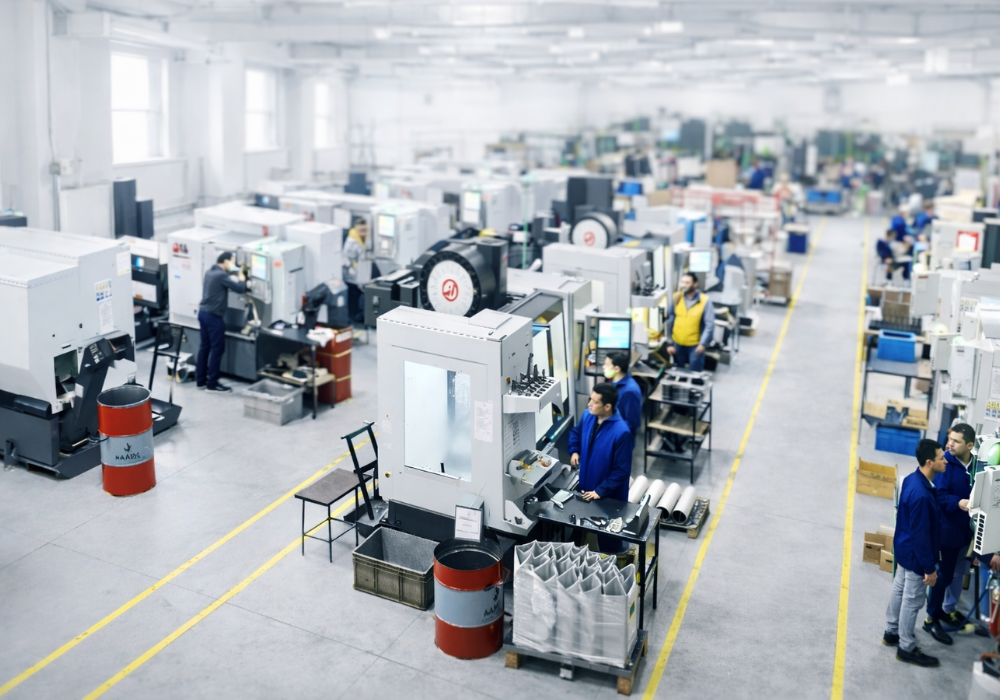
CNC boring process CNC Boring & Large Machining

CNC boring and large-scale machining for welded frames, thick plates and structural components — engineered for alignment, concentricity and controlled dimensional stability.

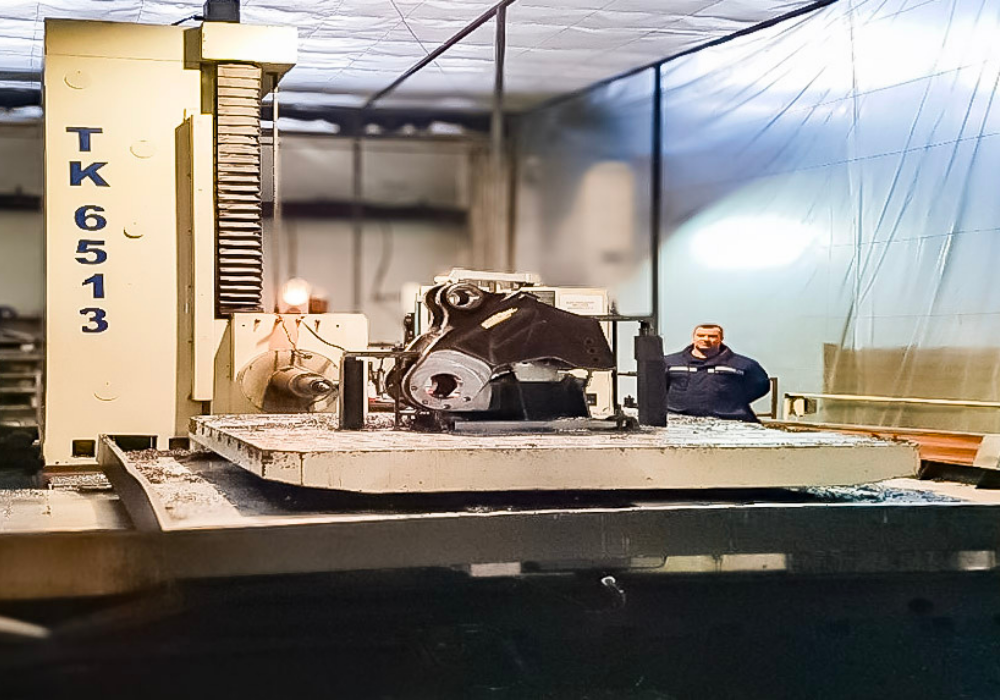
360° rotary tables Large welded structures Controlled heavy machining
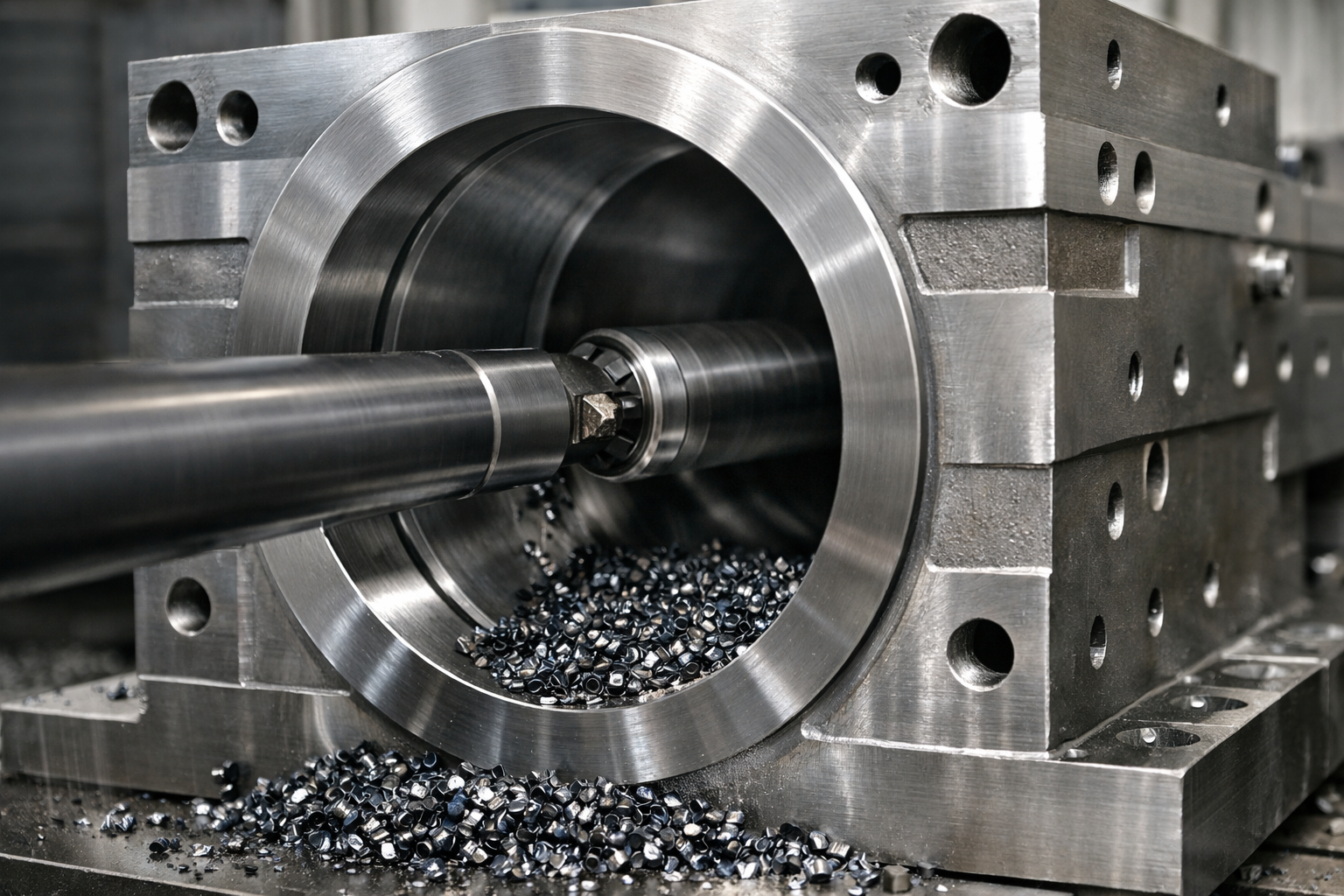
  • Boring, face milling and planar machining for heavy structural components.
  • Alignment and concentricity machining for multi-bore interfaces.
  • Final requirements confirmed during RFQ review and technical alignment.

Positioning

CNC boring positioned for large, load-bearing and welded structures where geometric alignment, bore-to-bore accuracy and planar stability are critical for downstream assembly.

  • Focus on alignment-critical bores, mating faces and structural reference planes.
  • Optimized for RFQ evaluation and controlled, repeatable large-part machining.
Scope boundaries

Intended for heavy components with defined datum structures and realistic tolerance schemes.

  • Part suitability confirmed during RFQ (mass, rigidity, bore layout, tolerance stack).
  • Final machining strategy defined after drawing review and technical alignment.

Integration with welding & inspection

Boring operations are aligned with welded fabrication stages and dimensional inspection requirements.

  • Machining strategies adapted to welded assemblies and residual stress behavior.
  • Bore alignment and planar references prepared for assembly and metrology.

Quality & risk control

Risk factors related to size, mass and rigidity are identified early and addressed through controlled setups.

  • Controlled datum strategy and sequence planning for large components.
  • Dimensional risks reviewed and documented prior to series machining.

Customer interface

Structured technical interface for clarification of geometry, tolerance and process requirements, with disciplined communication throughout the quotation phase and the part lifecycle.

RFQ intake
Drawing review → mass & geometry check → machining concept alignment
Series support
Stable setups, documented sequences, predictable delivery rhythm
CAPABILITY STATEMENT

Large-part machining for reliable alignment and dimensional outcomes

Our boring capability supports heavy, dimensionally demanding components where rigidity, alignment and process stability are essential for downstream assembly and long-term performance.

All parts are manufactured build-to-print, strictly according to customer drawings and specifications.

MANUFACTURING LIMITS

Clear boundaries that guide RFQs and ensure predictable outcomes

Typical values below reflect stable, repeatable production conditions. Final requirements are aligned during RFQ review.

Process scope

  • Primary capability Boring + milling
  • Rotary table 360°
boring face milling planar machining deep drilling alignment machining

Achievable quality

  • Typical surface finish (large parts) Ra 1.6 – 3.2 µm
  • Typical dimensional tolerances (large parts) ±0.02 – ±0.05 mm

Dimensional capacity

  • Max workpiece size (X / Y / Z) Up to 3500 × 2500 × 1250 mm
  • Rotary table Machine-dependent

Setup & stability

  • Typical workpieces Heavy structures
  • Process objective Alignment-ready

Final tolerances, surface requirements and process constraints are confirmed during RFQ review and technical alignment.

PRODUCTION SCOPE

From evaluation assemblies to repeatable large-part machining programs

Prototype and validation machining

Dimensional validation of large welded frames, thick plates and alignment interfaces.

Low- to medium-series production

Stable setups, controlled process windows and repeatable outcomes for heavy components.

Repeatable machining programs

Batch-to-batch consistency, documented setups and predictable delivery cadence.

OPERATIONAL CONTEXT

Context for evaluation

Practical overview for RFQ assessment. Detailed machine-level parameters are aligned when your drawing set is reviewed.

Material range

  • Carbon & alloy steels
  • Structural steel plates
  • Welded steel assemblies
  • Other materials upon request

Resources (overview)

  • CNC boring machines with 360° rotary tables
  • Extended axis travel capacity for heavy structural components
  • Fixture strategy aligned to rigidity and alignment targets

Typical components

  • Large welded frames
  • Thick plates and large flanges
  • Structural machine elements
  • Multi-bore alignment plates
  • Large housings and load-bearing interfaces
CNC boring environment photo 1
CNC boring environment photo 2